Most of our lives have been defined by an endless string of deadlines.
School deadlines.
Work deadlines.
Career deadlines.
Financial deadlines.
Family obligations.
Like most people, I’ve spent decades responding to expectations—fixing problems, meeting demands, and running on a clock that was never truly my own.
I told myself that someday, I would be free of these things. Free to pursue my dreams and passions. Free to control my time. I even kept a George Eliot quote on my refrigerator to encourage me that managing professional and family life had not yet stolen my dreams and passions:
“You’re never too old to be what you might have been.”
Well that someday has arrived. Commitments have lightened. Work has slowed and moving toward retirement. And many of those daily deadlines have begun to disappear.
Great, right?
Well, yes.
All those things I professed I wanted to pursue are now in reach. But there was some initial unexpected reluctance and resistance that gnawed at me. I had minimized how deeply conditioned I was to measure life through productivity, responsibility, outcomes and meeting the needs of others. So much of my identity has been shaped by my profession and what I produced rather than how I lived.
Perhaps most unsettling is the realization that my identity includes a lifetime of excuses for why I had no time for music, writing, art and travel. But now, life is calling my bluff. It is forcing me to unlearn a pattern of behavior that created obstacles to my stated goals and happiness.
This education includes five things I’d like to share about what I am learning as I shift into a life free of deadlines, a second act, if you will.
1. Face Yourself: No More Excuses
The possibilities suddenly feel endless.
For me, that freedom shows up as opportunities for writing novels, playing music, painting, traveling, and learning a new language. For someone else, it might mean restoring a classic car, becoming a woodworker, a gardener, reading the classics, volunteering in the community, or finally diving into subjects that once felt out of reach.
The sky is the limit. Truly.
Then reality hits.
I found myself unexpectedly stuck—not because I lacked options, but because I suddenly had too many. Along with that came a quiet, irrational fear of failure.
Eventually, a simple truth surfaced: The excuses are gone.
All the things I used to say I didn’t have time for?
Now I do.
That realization is sobering and a bit scary. If I want a life filled with curiosity, creativity, and meaning, it’s now entirely up to me. No fingers to point at anyone or anything.
2. Learn to Be, Not Just Do
This may be the most important mental shift I am trying to make.
For most of my life, I was trained to believe that value comes from doing—producing, achieving, earning, finishing, moving on to the next thing that will bring happiness. Some of this may be imprinted from my own father, who was a Type-A physician with intense focus and energy.
But I’m realizing the second act introduces a different way of looking at the world. Some of the most meaningful moments now have nothing to do with output, but just being present.
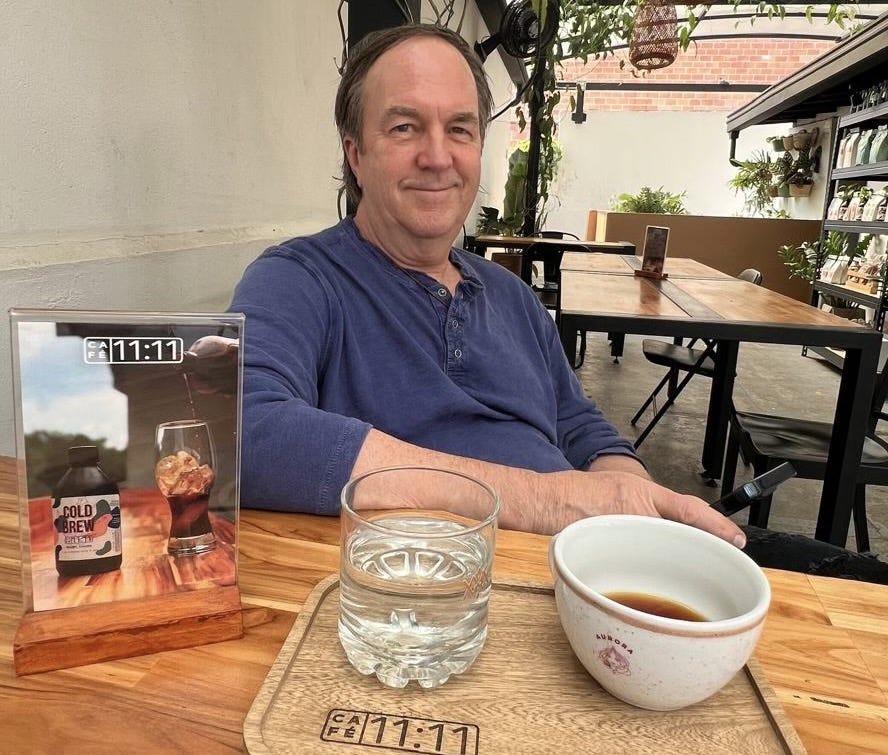
Sitting with a cup of coffee and actually tasting it—instead of rushing through it on the way to something else.
Watching hummingbirds in the backyard without thinking about yard work.
Taking a nap in the middle of the afternoon simply because I feel like it.
There’s a kind of patience that begins to emerge. A willingness to let moments unfold instead of constantly trying to optimize them.
It creates a strange but powerful paradox.
Yes, I’m pursuing things I’ve always wanted to do but holding those pursuits more lightly than I once would have. Engaging fully, without tying my happiness to results. Learning how to be the person I always thought I needed to become, rather than constantly trying to prove that I am one.
3. Release Self-Imposed Pressure
For years, pressure was normal part of every day. Deadlines. Expectations. Responsibilities.
The American work culture rewards busyness, and over time it becomes part of your identity, a cultural badge of honor.
“I’m swamped.”
“I’d love to, but I can’t.”
“Things are crazy right now.”
But there is no need for pressure now. Everything can run on its own time. I get to define success on my own terms. My pace. My priorities. My standards.
And without that constant weight, I’ve noticed something surprising:
I can try things more freely.
I can get things wrong. I can start again.
And nothing falls apart. The world keeps spinning.
4. Do Things for Their Own Sake
I dreamed for decades of losing myself in creativity.
But those interests were always tied to unrealistic expectations and outcomes—doing something meaningful, impressive, or successful in the eyes of others, as well as myself. In hindsight, that mindset was paralyzing. It made starting harder than it needed to be.
Now I write because I want to write. Will my novel get published? Maybe. Maybe not. That’s not the point. It’s a magical experience just putting pen to paper and watching a story unfold.
I play in low-key local bands. We’re not playing big gigs. We’re not touring. We’re not cutting an album. But I’m enjoying it more than I ever imagined.
Every once in a while, I pick up a palette knife and throw paint on a canvas. Abstract painting frees me from needing to create something recognizable. Some days I love what comes out. Other days I don’t. Either way, a few hours pass—and I feel like my soul has been to a day spa.
That kind of enjoyment doesn’t come from external approval.
When I stop focusing on outcomes, I begin to lose myself in the process. Time fades. The best moments happen when I’m no longer trying to manage them.
5. Design Your Days
There’s no instruction manual for the second act. No roadmap. No defined path. No one telling you what comes next. For the first time since childhood, the structure is largely gone.
This means something new takes its place – we can be the true architects of each day.
Deciding what matters. Following curiosity. Creating a life that feels meaningful.
All this requires intention. Being true to yourself. Making a daily decision to honor your gift of freedom.
So what are you going to do with it?
Throw up the white flag and tell yourself life has passed you by?
Settle into a comfortable routine until old age?
Run out the clock watching TV as a couch potato?
Or do you want more?
In his song, Like A Rolling Stone, Bob Dylan sings: “You shouldn’t let other people get your kicks for you.”
If that speaks to you – and you now have more free time on your hands – I hope my experiences will help you find the deepest part of you, the part you are meant to live whatever you want to do with it.
What now? It’s your time.
If this resonated, you’re welcome to follow along on Substack